


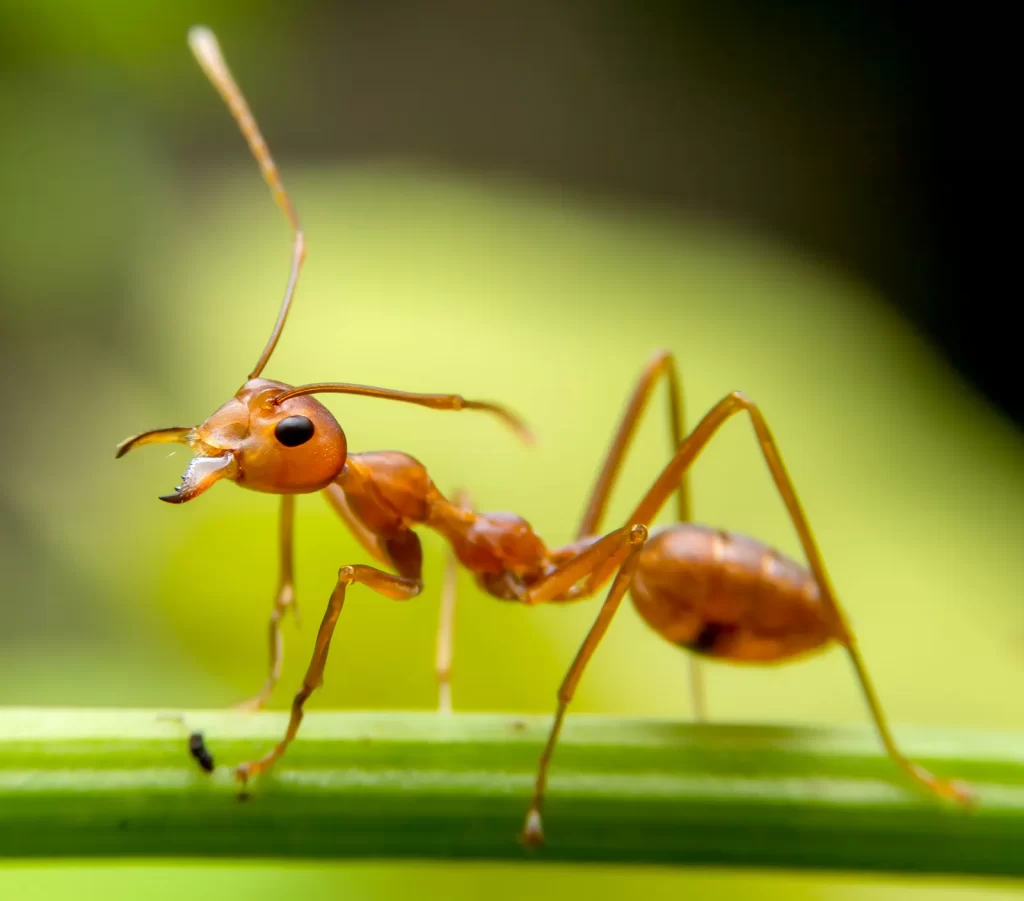
Ants are among the most prevalent pests in households. Ants also invade restaurants, hospitals, offices, warehouses, and other buildings where they can find food and water.
On outdoor and sometimes indoor plants, ants protect and care for honeydew-producing insects such as aphids, soft scales, white-flies, and mealybugs, increasing damage from these pests. Ants also perform many useful functions in the environment, such as feeding on other pests (e.g., fleas, caterpillars, and termites), dead insects, and decomposing tissue from dead animals.

General biology and behavior
Ants belong to the insect order Hymen-optera and are close relatives of bees and wasps.
Ants belong to the insect order Hymen-optera and are close relatives of bees and wasps.
The ant’s body is constricted, giving it the appearance of having a thin waist, while the
termite has a broad waist.
The ant’s hind wings are smaller than its front wings, while the termite’s front and hind
wings are about the same size. However, shortly after their flights, both ants and termites
lose their wings, so wings usually aren’t present.
Winged female and worker ants have elbowed antennae, while the termites’ antennae
aren’t elbowed.
After a few years, the colony begins to produce winged male and female ants, which leave
the nest to mate and form new colonies.
Argentine ants differ from most other ant species in that their nests are often shallow,
extending just below the soil surface.
However, under dry conditions they will nest deeper in
the soil. In addition, Argentine ant colonies aren’t separate but linked to form one large
“supercolony” with multiple queens. When newly mated queens disperse to found new
colonies, they are accompanied by workers rather than going out on their own as most other
species do.
The winged female reproductive mates with a male reproductive either during the swarming
flight or on the ground. The male dies shortly afterwards.
The female then digs or adapts a cavity, usually in the soil, and walls herself in. At this time,
if her wings are not already broken off, she tears them off. She then produces eggs.
When the tiny, white, legless grubs (larvae) hatch, they are fed with salivary secretions from
the female’s stored fat cells and the breakdown of her now useless wing muscles.
After several molts, the larvae change into soft, white, pupae that look like motionless,
white adults
Ants: Prevention, treatment & management
Signs of ant infestation
Anthills – An ant infestation can be indicated by small piles of soil around holes in the ground and at the base of exterior walls. Some ant species like to inhabit walls or other quiet, dark places, making an infestation even harder to detect.
Ant Trails – Some types of ants will lay a pheromone trail to a food source. This chemical attracts other ants to find the food.
Live ants – If you see large numbers of live ants in your home or business, you may have an ant problem. If you find them in your kitchen or food preparation areas, you need to do something about it as soon as possible.
Factors contributing infestation
• Uncovered leftover food.
• Unsecured garbage, pet food, compost piles, and even outdoor water sources can attract cockroaches. All trash bins must be stored far away from the house.
• Poor hygiene. Split food waste and dirty utensils.
• Leaving baking ingredients or confectionery products in open storage packages or boxes.
Prevention
Secure Garbage: Use heavy-duty trash bins with tight-fitting lids. Keep trash cans away from doorways and the ground where ants forage. Feed pets outdoors. Store away pet food in large containers and remove uneaten food quickly if feeding pets outside.
Sanitation. Ants thrive where food and water are available to them. Even tiny amounts of crumbs provide a food source.Store food in insect-proof containers such as glass jars or re-sealable plastic containers.
• Refrigerate left over food especially confectionery products.
• Never plant lawn along the edges of the house.
Ant control services & Integrated Pest Management
Site inspection
We will conduct an assessment of your property and determine a suitable ant control solution for
your premises and costs. We provide written assessment reports.
DIY ant control products
Our DIY products can help you manage ant infestations, if the ant population is minimal i.e granular and gel baits and dusters
Professional ant control
For larger ant infestations will require an assessment by professional pest control
technicians will implement fast and efficient ant control solutions using internationally approved materials and procedures with guaranteed results. Our ant control solutions involve applying a chemical (pyrethroids) in high infestation areas of your buildings, offices and warehouse.
We use internationally approved chemicals and control methods.
Ant baiting & monitoring
• We use granular and gel baits with guaranteed results.
• To act as a strong defence against ants, we put in place a pest management solution to help
control the ant population and prevent the infestation from reoccurring.
• We will also use integrated pest management solution that will help minimise chance of re-
infestation or growth.
Frequent inspections & monitoring of bait stations
To give you peace of mind, we perform inspections before and after construction, to get rid of ant before they cause serious implications.
Based on the layout of your property and possibility ant infestation, Ultimate Pest Control
Services will create a customized prevention & control plan tailored for your situation.
Pesticide application
• Pest control technicians will need to double their efforts in analysing every ant infestation, taking into consideration ant species, and should be prepared to use more than one technique to bring the infestation under control.
• We use pesticide formulations that are not readily absorbed by porous surfaces (concrete floors, bricks, stones, soil, etc.). These are applied in cracks and crevices and ant nests.
• We apply pesticides as outside barriers or spot treatments when they can be safely used in areas of known infestation.
• We use granular baits to quickly reduce large populations indoors and outdoors in lawn areas.
• We also use large bait stations. These are effective when properly placed in proper quantities.
• We also use sex pheromone is available to attract males to traps.
Follow up
Ongoing monitoring is important in observing the ant species prevalent in the area requiring
treatment.